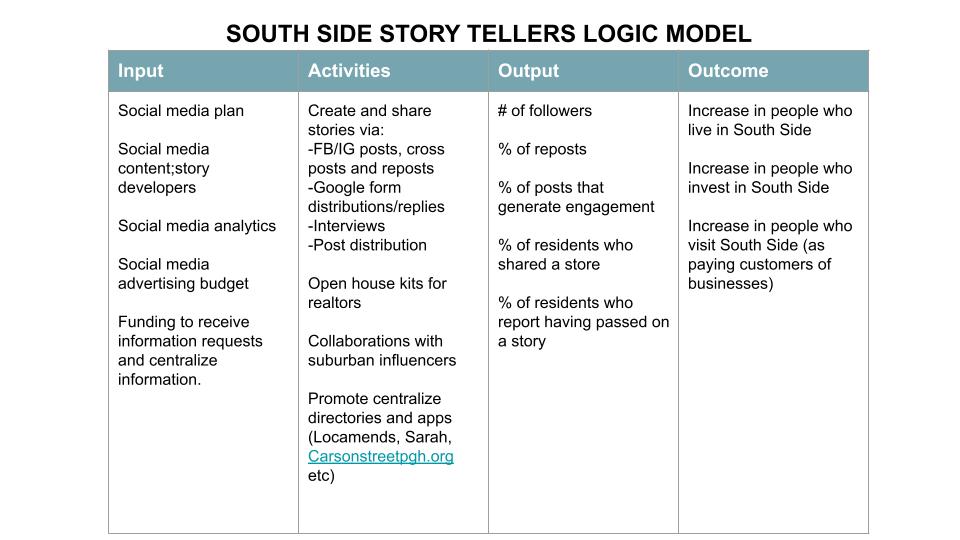
1. What This (out of the blue) Logic Model Actually Describes
The model is built around content production + social amplification + community engagement, all designed to produce three outcomes:
– more people living in South Side
– more people investing in South Side
– more people visiting South Side (as paying customers)
The model is entirely PR + storytelling + awareness mechanics. No operational infrastructure, no sustained service layer, no knowledge system. Only content → engagement → perception shift → economic lift.
This is important, because it makes the model compatible with Sarah, not competitive — but only if the roles are clearly defined.
2. Where It Aligns Perfectly With South Side Sarah
Several elements in Annette’s logic model directly match the functionality and purpose of Sarah.
A) Centralizing information is listed as a needed input
The model names the need for:
“Funding to receive information requests and centralize information.”
South Side Story Tellers Logic …
Sarah already does that.
Sarah is the centralizer.
This is the clearest overlap, and it strengthens the case for why Sarah is the infrastructure underneath the storytelling campaign.
B) Promotion of directories and apps
The model explicitly lists:
“Promote centralized directories and apps (Locamends, Sarah, Carsonstreetpgh.org etc)”
South Side Story Tellers Logic …
This positions Sarah as one of the main channels the PR operation is supposed to drive people toward.
That is completely consistent with your vision.
C) Stories as content inputs for Sarah
The activities focus on:
– interviews
– Google form submissions
– stories shared by residents
– story developers
– reposts and cross-posts
South Side Story Tellers Logic …
These become the exact type of curated inputs Sarah can digest into its knowledge base.
In other words:
Storytelling supplies raw material.
Sarah organizes and delivers it at scale.
D) Desired outcomes fit Sarah’s strengths
The outcomes (increase residents, investment, visitors) are not achievable from social content alone. They require:
– daily utility
– accurate information access
– navigation help
– visibility for businesses
– consistent, trustworthy answers
Sarah is the only part of the system that can deliver those tangible, utility-based interactions.
PR alone might spark interest; Sarah turns interest into usable experience.
3. Where There Is Potential Misalignment or Redundancy
The logic model does not conflict, but it does leave some gaps or blurry roles that must be addressed or things will get confusing.
A) The model implies manual labor that Sarah automates
The inputs mention needing:
– social media analytics
– staff to receive info requests
– story developers
– centralized information workflows
South Side Story Tellers Logic …
If not clarified, this creates redundancy.
Sarah eliminates much of this manual burden by automating:
– intake
– organization
– tagging
– answer delivery
– request handling
You don’t want volunteers doing work that Sarah already handles better.
B) Measurement is limited to social metrics
“# of followers,” “% reposts,” “% engagement,” “% residents who shared stories.”
South Side Story Tellers Logic …
These are weak indicators of neighborhood vitality.
They don’t capture:
– what people actually need
– what visitors ask
– which businesses benefit
– what trends are emerging
Sarah provides real behavioral data, not vanity metrics.
If the group leans too hard on social metrics, they miss what Sarah uniquely offers.
C) No mechanism in the model for long-term sustainability
The model depends on:
– advertising budgets
– content developers
– influencer collaborations
South Side Story Tellers Logic …
These are fine for campaigns but not durable.
Sarah’s sponsor model is durable.
Without Sarah, the model becomes a temporary PR push that fizzles when energy or funding dries up.
D) Overlap between “centralized information” and PR’s desire to control the narrative
Sarah is neutral and factual.
PR efforts sometimes try to push positive stories over accurate ones.
This needs alignment so Sarah doesn’t become pressured to bend truth into marketing.
Just define the boundary:
Storytelling = narrative.
Sarah = facts + service.
4. How to Integrate the Logic Model Into the South Side Sarah Framework
Here’s the clean, conflict-free alignment:
The PR model becomes the content engine.
It generates:
– stories
– resident testimonials
– business highlights
– interviews
– community wins
All of this can feed Sarah’s knowledge base.
Sarah becomes the delivery engine.
It provides:
– 24/7 accessible neighborhood intelligence
– centralized and maintained information
– accurate business listings
– event routing
– navigation help
– call-in voice support
– community data insights
Together, they produce the outcomes the logic model targets
More residents
More investment
More visitors
More pride
More cohesion
The logic model becomes the front-of-house.
Sarah becomes the back-of-house infrastructure.
5. The Only Real Risk
If the team tries to run a PR strategy without integrating Sarah as the information backbone, then:
– volunteers will burn out
– information will get outdated
– stories won’t translate into useful action
– the campaign will surge and fade
– the centralization goal will fail
Sarah is the tool that prevents fatigue and keeps the campaign alive long after the social media energy ebbs.
Bottom Line
Annette’s logic model is compatible, useful, and aligned — but it must be positioned as the storytelling and outreach layer, not the infrastructural solution.
South Side Sarah is the system that operationalizes, sustains, and amplifies everything the logic model attempts to accomplish.